
Diagnosing a Stuck Thermostat: 2010 Ford Fusion 2.5L
A 2010 Ford Fusion 2.5L (6F35 transaxle) was running noticeably cool under load and taking a long idle to reach temperature. OBD-II datalogging confirmed a flow-dependent cooling fault consistent with a stuck-open or early-opening thermostat, and post-replacement logs confirmed a return to a normal warm-up curve and a stable ~210–217°F regulated operating band under both idle and highway driving.
Subtle Symptoms
Nothing threw a code. The car wasn't overheating — it was the opposite, and that's part of why it went unnoticed for a while. The first real flag came from an offhand idle observation: coolant temperature climbing to 204–206°F after a drive, well after the engine should have already settled into a steady operating range rather than still visibly rising at idle.
That observation only made sense once held against the rest of the driving picture: on a separate occasion, after roughly 30 minutes of mixed highway and stop-and-go driving, a quick coolant check immediately after parking showed only 158–163°F, creeping up just 5°F in the next 98 seconds. Two readings, same car, wildly different numbers — one far too cold for sustained driving, one that looked like a normal warm idle climb. Neither one by itself was alarming. Together, they were a contradiction worth chasing: an engine that sometimes idles its way up into a believable range, but can't hold temperature under real driving load.
Diagnostics
The tool was a phone running Torque Pro against the OBD-II port, logging Engine Coolant Temperature, RPM, OBD speed, intake air temperature, and fuel trims at roughly 10 Hz, exported as CSV and analyzed in Python (pandas) rather than eyeballed live.
A single short reading is easy to misread — a sensor's resolution, a momentary dip, a polling hiccup. Several things showed up only once the logs were pulled apart in detail:
- Sentinel/dropout values. Some fields occasionally reported
3.4e38(float-max) during brief OBD disconnects; these were filtered out rather than treated as real RPM or speed. - Logging gaps. One long idle session had a 13.4-minute gap where RPM and coolant both froze at stale values — the Bluetooth link had dropped, not the engine. RPM snapped back to a normal idle figure the instant logging resumed, confirming the engine had kept running throughout.
- Quantization. Coolant temperature stepped in clean 1.8°F (1°C) increments — normal OBD-II PID resolution, not noise.
Once cleaned, the logs were split into driving segments (OBD speed > 1 mph) and idle segments, and the coolant curve was examined separately for each. That split turned out to be the key: the fault only showed up as a pattern across flow conditions, not in any single number.
Driving (Sept 29, ~9.3 min, highway speeds up to 72 mph, avg 41 mph): coolant oscillated between 163–174°F the entire time and never once exceeded 174°F, despite sustained speed and load.
Idle immediately after (~7.4 min): coolant climbed to 174°F, then 181.4°F, spiked briefly to 195.8°F, then fell back down to 179.6°F and flatlined there.
Extended idle (a separate ~32-minute session, logging gap included): coolant never recovered toward a normal plateau. It peaked at 195.8°F only momentarily, then declined over the following ~20 minutes to settle at a flat 170.6°F for the final 8+ minutes of the log — losing ground at idle rather than gaining it.
Root Cause
The pattern across the logs pointed at the thermostat rather than the coolant temperature sensor (ECT) or anything electrical, for three reasons:
- Flow-dependent, not a fixed offset. A failing ECT sensor reads a consistent offset or drifts regardless of engine load. This fault was the opposite: temperature was capped low specifically under high coolant flow (highway driving) and only climbed when flow dropped (idle). A sensor fault doesn't know what the coolant pump is doing; a thermostat does.
- The rise-spike-fall shape. During the first idle session, coolant rose to 181.4°F, spiked to 195.8°F, then fell back to 179.6°F and held. A real sensor fault doesn't produce a reading that climbs, jumps 15°F, and then drops back down to a new, lower, stable plateau. A thermostat cracking open, admitting a slug of cooler fluid from the radiator loop, and reclosing produces exactly that shape.
- No condition reached normal operating temperature. Not highway driving, not a short idle, not a 32-minute idle. A properly functioning 6F35-equipped 2.5L Duratec should settle into roughly 195–220°F under any of these conditions. None did — driving capped at 174°F, and the longest idle session actually trended down to 170.6°F over time.
Taken together: a thermostat stuck open, opening well below its rated temperature, or no longer reliably closing — letting coolant bypass to the radiator before the engine reaches operating temperature, and unable to hold heat in the block once there.
Corrective Action
The corrective TO was straightforward given the diagnosis: replace the thermostat — a Murray Plus 180°F unit from O'Reilly (listed under part #4138 on O'Reilly's year-filtered fitment page, though #3468 also surfaces for this application in general search; worth confirming against the receipt before a reorder) — along with a new housing gasket, rather than chase the ECT sensor or wiring. No other cooling-system components — water pump, radiator, fans — showed symptoms consistent with their own failure in the logged data, so the thermostat was treated as the sole suspect and swapped as a complete unit rather than attempting to clean or test the old one in place.
The diagnostic data is what made this a one-part fix with high confidence going in, rather than a parts-cannon guess: the flow-dependent cap and the rise-spike-fall signature in the idle log are not symptoms a water pump, a radiator fan, or a sensor produce on their own.
The housing bolts torqued to 89 in-lb (10 Nm) — a field-sourced figure (commonly cited from Haynes manual data for this engine family), not a WSM-verified factory spec. Access was the fiddly part: three 8mm housing bolts, with the lower inner one a blind fastener with no direct sightline, reachable only with a stubby 1/4-in drive ratchet and a short extension.
Because this is a sealed, pressurized system with no dipstick-style level check, the refill wasn't just "top it off and go." The full procedure — drain, flush, refill, and bleed — is written up separately as TO-COOL-301, including the bleed screw location (a small screw cap near the oil dipstick on this vehicle) and an explicit warning against opening the radiator or reservoir cap while hot: on a pressurized system, that doesn't vent trapped air the way the bleed screw does — it forces scalding coolant and steam out instead.
Confirmation Analytics
Torque Pro OBD-II logs, Sept 29 and Oct 1–2, 2026 · minute-resampled
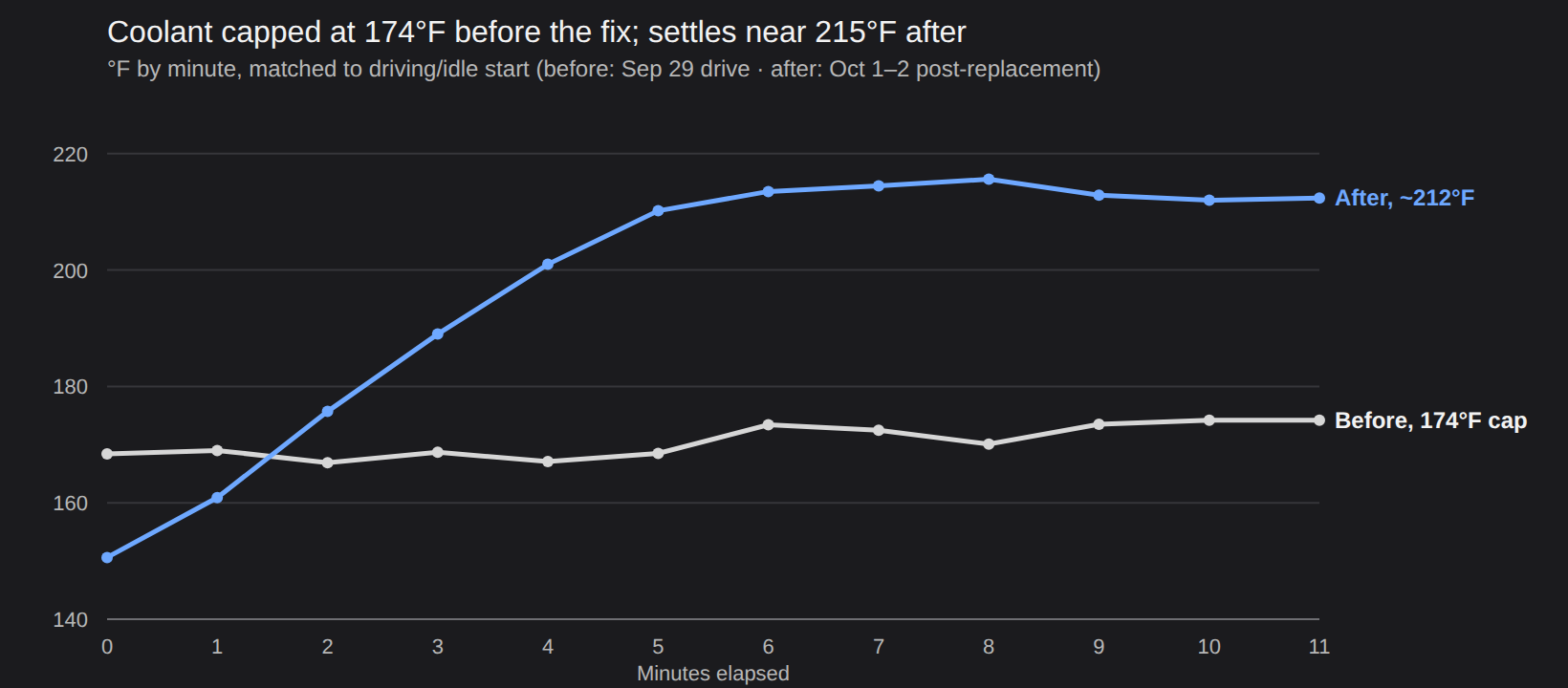
The clearest single exhibit is a direct comparison, minute by minute from the start of each log: before replacement, coolant oscillated in the mid-160s to 174°F and never broke that ceiling; after replacement, the same elapsed time shows a clean climb settling into a ~212–217°F regulated band.
Three post-replacement logs back this up independently:
- Cold start → 199°F (first ~4 min): coolant climbed smoothly and monotonically from 149°F to 199.4°F at idle, decelerating as it approached the thermostat's opening point — the signature of a thermostat properly holding heat in the block during warm-up.
- Continued idle → plateau (minutes 4–11): the climb kept decelerating and leveled off, holding in a tight 212–216°F band for over 4 minutes — oscillating by a single ~1.8°F step rather than climbing further or sagging back down, consistent with the thermostat cycling to hold a setpoint.
- Real driving the next morning (16.5 min, cold start through highway speeds up to 65.9 mph): coolant again climbed cleanly from a 102.2°F cold start and then held 206–217.4°F through ~8.75 minutes of mixed idle and highway driving — the condition that most clearly exposed the original fault, now resolved.